A short dictionary for people getting floor estimates. Where a term has a number attached, it comes from NWFA (the National Wood Flooring Association), a manufacturer data sheet, a trade publication or a wood reference site. The guide pages list the sources, and the FAQ has longer answers.
- Aluminum oxide
- A hard mineral added to factory floor finishes to resist scuffs. It makes later sanding much slower. Trade guidance says to expect a bid 30 to 40 percent higher to refinish it.
- Basket weave
- A parquet pattern built from blocks of boards, alternating direction like a woven basket.
- Bevel
- A small angled edge on prefinished boards. Sanding removes it.
- Buckling
- Boards lifting off the subfloor from extreme moisture. NWFA says buckled floors need replacing.
- Chevron
- A zigzag pattern where board ends are cut at an angle so they meet in a continuous V. Herringbone, by comparison, uses square-ended boards.
- Coat
- One layer of finish. Two is the minimum on the main waterborne products, and three is recommended for heavy traffic.
- Conversion varnish
- An extremely durable finish with strong fumes. VOC is about 725 g/L.
- Crowning
- A board whose center sits higher than its edges. It often shows up after sanding a cupped floor before it dried.
- Cupping
- Board edges higher than the middle, from unequal moisture between the top and bottom.
- Cure
- The time a finish takes to reach full hardness. It runs from about 3 days for some waterborne finishes to about 30 days for oil-modified ones.
- Dustless sanding
- Sanding with the machine connected to a HEPA vacuum. Systems vary, and not all capture the same share of dust.
- Engineered wood
- A real-wood top layer glued to plywood. The top layer is 1/16 to 1/4 inch thick.
- Expansion gap
- The space left at the walls for wood to swell. NWFA guidance has called for about 3/4 inch, hidden by baseboards.
- Feeler gauge
- A thin metal strip used to measure how much wood is left above the tongue of a board.
- Floating floor
- A floor that is not nailed or glued to the subfloor. It locks together at the edges.
- Grit
- The roughness number of sandpaper. Lower is coarser. A last cut between 80 and 120 is typical before stain.
- Hardwax oil
- A natural oil-and-wax finish with near-zero VOC. It is easy to spot repair but needs maintenance oil every few years.
- HEPA
- A very fine filter, used on vacuums connected to floor sanders.
- Herringbone
- A pattern of short square-ended boards laid in a zigzag. It needs a very flat subfloor.
- Janka hardness
- A number for how hard a wood is. Red oak is about 1,220 to 1,290. Douglas-fir is 620 to 660.
- Lacing
- Weaving new boards into old ones so a repair disappears. Also called weaving or blending.
- Mastic
- The sticky adhesive under old vinyl tile. It can contain asbestos in older homes.
- Moisture content
- The share of a board’s weight that is water. Flooring wood is typically 6 to 9 percent, and planks should be within 2 percent of the subfloor.
- NWFA
- The National Wood Flooring Association, the main trade group and the source of most installation and refinishing guidelines.
- Oil-modified polyurethane
- A traditional amber finish. Slow drying, forgiving, stronger odor.
- Parquet
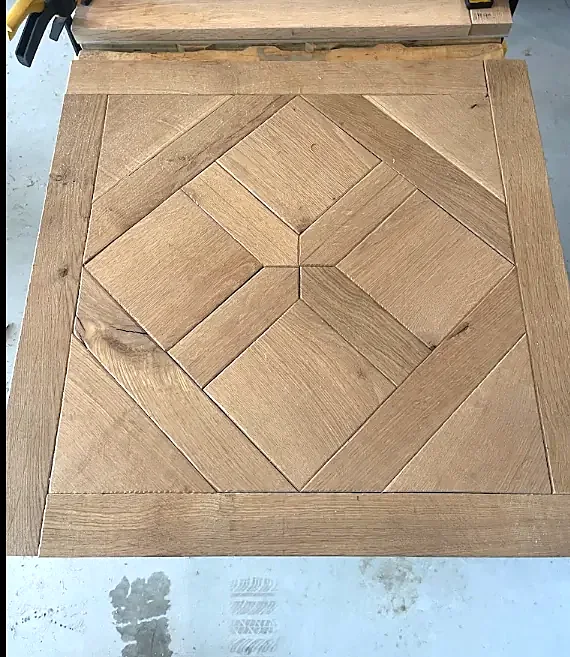
- NWFA’s word for any geometric floor pattern, as opposed to straight rows.
- Plank
- NWFA’s term for boards three inches wide or wider.
- Polyurethane
- The most common clear finish for wood floors. It comes waterborne or oil-modified.
- Prefinished
- Boards stained and sealed at the factory before installation.
- RRP rule
- The EPA’s Renovation, Repair and Painting rule for lead-safe work in homes built before 1978.
- Screen and recoat
- Scuffing the old finish and adding a fresh coat without sanding the wood. Also called a maintenance coat.
- Sheen
- How glossy a finish is. Extra matte is about 7 to 10 percent gloss, satin about 15 to 25, semi-gloss about 40 to 45.
- Slab
- A concrete foundation floor. Slabs are moisture-tested before wood or vinyl goes on.
- Solid hardwood
- One piece of wood throughout, often about 3/4 inch thick.
- Subfloor
- The structural layer, usually plywood or boards, that the finished floor is attached to.
- Tannin pull
- Brown marks that can show when waterborne finish draws natural tannins from white oak, especially over gray or pastel stains.
- Termite pellets
- Six-sided droppings pushed from kick-out holes under 2 mm. A sign of drywood termites.
- Tongue and groove
- The interlocking edges of hardwood boards.
- VOC
- Volatile organic compounds, the solvents in finishes that cause odor. Measured in grams per liter. Local air districts limit them.
- Water pop
- Lightly wetting a sanded floor to open the grain so stain takes evenly.
- Wear layer
- The wood above the tongue that can be sanded. NWFA says not to sand below 3/32 inch.
- Wire-brushed
- A textured surface from brushing out the soft grain. It cannot be refinished the normal way.