
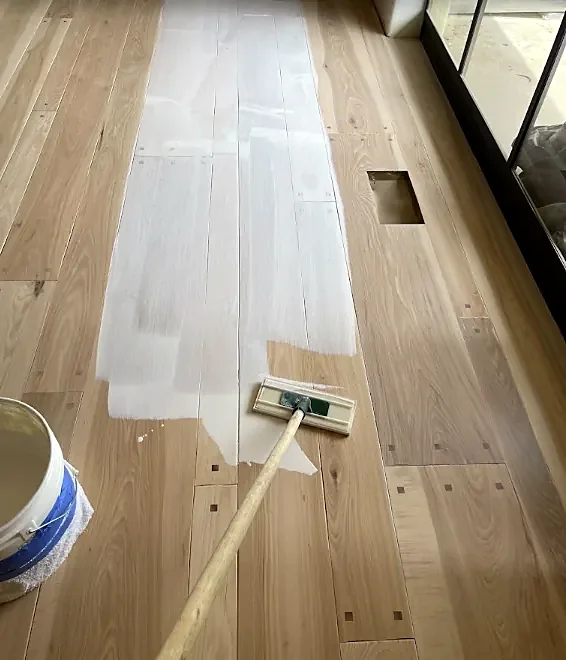
Refinishing sands off the old finish and a thin layer of wood, adds stain if you want a new color, then lays down new coats of finish. Most solid hardwood can be refinished several times. The National Wood Flooring Association (NWFA) says a floor should not be sanded once less than 3/32 inch of wood is left above the tongue. La Cumbre sands and refinishes hardwood across Santa Barbara and Ventura Counties, and a typical one-to-three-room job takes four to seven days. Estimates are free.
Can my floor be refinished?
It comes down to how much wood is left to sand. Each sanding takes off between 1/32 and 1/16 inch, according to NWFA.
| Floor | What the sources say |
|---|---|
| Solid wood, about 1/4 inch or more of wear layer | NWFA: most can be sanded six to eight times. One trade expert says up to about five, keeping 1/8 inch above the groove. |
| Engineered wood | Wear layers run 1/16 to 1/4 inch. Below 3/32 inch (about 2.4 mm), do not sand. No source gives a count of sandings. |
| Wire-brushed or heavily textured | NWFA lists textured floors with uneven surface depth as ones that cannot be refinished the normal way. |
| Beveled-edge boards | Sanding removes the bevel. |
You can measure a floor without tearing anything up. At a heating vent opening or a doorway transition you can see the wood layer from the side. Between boards, a feeler gauge slipped down to the tongue also works on solid wood (NWFA). Nail heads get set below the surface before sanding.
Signs you may need new boards instead: pieces that are eaten, rotted or cupped beyond saving, and engineered floors with a paper-thin top layer. Those are repairs first. See floor repair.
Sometimes there is hardwood under the carpet, and it is worth checking. La Cumbre removes carpet, and Tony can tell you what shape the wood is in.
Full sanding or screen and recoat?
A screen and recoat scuffs the old finish and adds a fresh coat. NWFA says that unless the floor has visible dents, wear patterns or permanent cupping, a maintenance recoat may be enough. It costs less and takes less time. It cannot change the color or fix a floor worn through to bare wood.
- Before a recoat: the floor has to be tested for wax, polish or grease. New finish will not stick over them.
- An easy check: wipe a worn spot with a damp towel. If the dull look disappears, a recoat will probably work. If it stays dull, the finish has worn through and the floor needs sanding.
- Factory finishes: recoating a prefinished floor can void the maker’s warranty. Check first. Aluminum-oxide finishes also take much longer to sand, and trade guidance says to expect a bid 30 to 40 percent higher.
What happens, step by step
- Prep. Furniture comes out. Carpet or old flooring is removed. Baseboards are taped.
- Repair. Bad boards and subfloor are fixed. Termite or water damage is cut out and new wood is laced in.
- Sand. A coarse paper levels the floor, then finer papers remove the scratches. Edges and corners get their own pass. Manufacturers typically want the last cut between 80 and 120 grit before stain.
- Color. Stain or a tint is applied, blended across mixed woods. A water pop, a light wetting that opens the grain, helps some woods take stain evenly.
- Finish. Coats of polyurethane or oil, with light abrasion between coats. Two coats is a minimum on the main waterborne products. A third is recommended for heavy traffic.
- Cure. The floor dries, then hardens over days to weeks depending on the product.
No single grit sequence fits every floor. It depends on the starting condition, which is why a contractor should look at yours first.
What about the dust?
Sanding makes a lot of fine dust. Systems that connect the sander to a HEPA vacuum capture up to 99.8 percent of it, according to a 2025 trade article. The same article says not all systems are equal, and that poor hose and shroud seals undermine them. Good job-site practice also means taping plastic over doorways, closing off heating and air returns, and covering vents.
How long does it take, and when can I walk on it?
On La Cumbre jobs, refinishing one to three rooms takes four to seven days. Furniture goes back three days after the last coat, and rugs after 30. Bona, the first finish on Tony’s list, is in the table below. Beyond that, no source gives a standard number of days per room, because it depends on the floor, the finish and the weather. Manufacturers do publish how long each finish takes to dry and cure. Go by the data sheet for the exact product your contractor uses.
| Finish | Between coats | Light foot traffic | Full cure |
|---|---|---|---|
| Waterborne polyurethane (Bona Traffic HD) | 2 to 3 hours | About 24 hours | 3 days; no rugs until cured |
| Waterborne polyurethane (Bona Mega ONE) | 2 to 3 hours | See data sheet | 5 days |
| Oil-modified polyurethane (Masterline 550) | 8 hours | Wait overnight | About 30 days; rugs after that |
| Hardwax oil (Ciranova) | About 6 hours | About 24 hours | About 7 days |
NWFA says to wait at least seven days after the last coat before putting rugs down. Keep pets off the floor until it has cured, and use felt pads on furniture from the first day.
Which finish should I choose?
| Finish | Look | Notes | VOC, g/L |
|---|---|---|---|
| Waterborne polyurethane | Clear, does not yellow | Fast drying, less odor, good wear | 0 to 450 (NWFA) |
| Oil-modified polyurethane | Amber, deepens with age | Slow, forgiving, stronger odor | About 275 to 550 |
| Hardwax oil | Natural, low sheen | Easy spot repair; needs maintenance oil every few years | Near zero |
| Conversion varnish | Amber | Very durable; strong fumes | About 725 |
Sheen changes how a floor looks. Manufacturer data sheets list satin at about 15 to 25 percent gloss and extra matte at 7 to 10. Lower sheens hide scratches and dust better. The Santa Barbara and Ventura County air districts limit solvent content (VOCs) in coatings. Ask which finish your contractor uses and what its VOC rating is.
Color and mixed woods
Red oak and white oak take the same stain differently, and older houses often have both after additions or repairs. One La Cumbre customer wrote that part of her floor was white oak and part red, and that Tony was able to add a tint to make it all blend. Her review is on the home page.
On trends: in NWFA’s 2025 survey, 63 percent of members choose white oak. The survey also shows gray and red tones declining while natural, light and brown tones gain. Gray and whitewash are the hardest colors to get right. Red oak’s pink undertone cannot be removed, oil finishes add yellow, and waterborne finish over white oak can pull out tannins and leave brown marks. Ask for a sample on your own floor, about three feet square, before committing. Try colors in the floor designer first.
Getting your home ready
- Clear the room. Rugs and furniture go out or into another room.
- Expect dust and fumes. Ventilate: NWFA suggests windows open and two box fans, one blowing in and one out. Finish odor is normal and usually not harmful.
- Plan for pets and children to stay out until the floor has cured.
- If your house was built before 1978, ask about lead-safe work. See older homes.
Mistakes to avoid
- Sanding a cupped floor before it has dried. It can crown later.
- Recoating over wax or polish without testing.
- Sanding an engineered floor with a thin top layer.
- Putting rugs down too early, or rubber-backed pads that mark the finish.
Sources
- NWFA, Hardwood Floors magazine: how many times can a wood floor be sanded, 2025
- NWFA, Refinish your floor, 2022
- NWFA, can a floor withstand a resand, 2019
- Wood Floor Business Q&A on sanding counts, updated 2026
- NWFA, recoating a previously finished floor, 2017
- Wood Floor Business, recoating factory finishes
- Wood Floor Business, trapping dust, Nov 2025
- Bona Traffic HD data sheet; Bona Mega ONE data sheet; Masterline 550; Ciranova hardwax oil
- Wood Floor Business, finish 101; NWFA, low-VOC finishes, 2018
- NWFA 2026 industry outlook, Oct 2025
- Wood Floor Business Q&A on stain color; tannin pull
- NWFA, finish odors
- NWFA, educating the customer on maintenance, 2017