
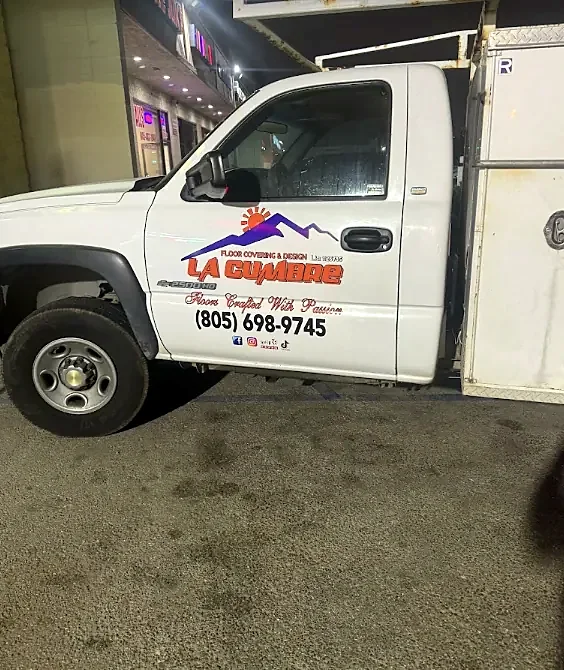
Before you hire anyone for floors in California, check the license on the state contractors board (CSLB) site, get a written contract, and do not pay more than $1,000 or 10 percent of the price up front, whichever is less. La Cumbre Floor Covering & Design holds California contractor license #1125785, and you can look it up yourself.
Check the license
Go to the CSLB’s “Check a License” tool at cslb.ca.gov, or call 1-800-321-2752 (CSLB). Type in the license number. Check that it is active and which classes it holds. Ask for proof of bond and insurance.
- Flooring class. C-15 covers surface prep and carpet, resilient flooring and wood floors, including finishing and repair. It excludes ceramic tile, which is a separate class.
- Small jobs. Since January 1, 2025, unlicensed work is allowed only up to $1,000, only with no hired workers and only when no permit is needed.
- Bond. Licensed contractors must carry a $25,000 bond, which exists to protect customers harmed by defective work.
Check a license on CSLB. La Cumbre’s number is 1125785. Tony carries a contractor bond, general liability insurance and workers’ compensation, so ask him for proof the same way you would ask anyone. La Cumbre is also accredited by the Better Business Bureau, rated A+. See the BBB profile.
What a California home improvement contract must have
The state’s home improvement law requires a written contract for projects over $500. The CSLB’s sample contract and consumer guide list what it should contain:
- The contractor’s name, address, phone and license number, and your name and address.
- A description of the work and the significant materials, in plain words.
- The total price, and any finance charge.
- Start and finish dates.
- A payment schedule. Each payment lists the amount and the work it covers. Payments cannot run ahead of the work done.
- Who pulls permits.
- Any warranty, in writing, with what is covered and for how long.
- The required notices: right to cancel, a mechanics lien warning, and insurance disclosures.
Down payment: the contract cannot ask for more than $1,000 or 10 percent of the price, whichever is less. A contractor with a blanket performance and payment bond is the exception.
Right to cancel: the CSLB guide gives three business days to cancel a standard contract, five if you are 65 or older, and seven for disaster repair. The right does not apply when you sign at the contractor’s place of business or for emergency repairs. Read the notice in your own contract, because that notice controls.
Change orders: any change to the work must be written, signed by both of you, and state the price change before the extra work begins.
Lien release: when you pay, the contractor must give you a full, unconditional release for that payment. That protects you from a supplier or worker who was not paid.
Ten questions to ask any flooring contractor
- What is your license number, and which classes does it hold?
- Do you have workers’ compensation and liability insurance? Can I see proof?
- Will you give me a written contract with a payment schedule and the notices?
- What exactly is included: removal, disposal, subfloor repair, furniture moving, baseboards?
- What finish, how many coats, and which sheen?
- How do you control dust?
- If you find damage under the floor, how is it priced and approved?
- What is your schedule, and when can we walk on the floor?
- Can I see photos of similar work and talk to a recent customer?
- What does the warranty cover, in writing?
Red flags
- No license number on the estimate, or a license that does not match the name.
- Asking for more than $1,000 or 10 percent to start.
- No written contract, or a contract that leaves out the finish and the number of coats.
- No mention of dust control.
- A promise to sand out cupping before the moisture problem is fixed.
- A quote for a factory-finished (aluminum oxide) floor at the same price as a regular one. That finish takes much longer to sand.
- For an engineered floor: a refinish quote without measuring the top layer.
- Pressure to decide today.
Older home? Lead and asbestos
Lead. If your house was built before 1978, federal law requires firms paid to disturb painted surfaces to be EPA-certified in lead-safe work. That includes giving you the “Renovate Right” pamphlet, containing the work area, and using HEPA-equipped tools. Ask whether the firm is certified. Owners working on their own home are generally exempt.
Asbestos. Older vinyl tile and the adhesive under it can contain asbestos. Federal safety rules say flooring of this kind must not be sanded, and leftover adhesive must be scraped wet. If you suspect it, have a sample tested by a certified lab before anyone tears it up. In Santa Barbara County, larger renovations can require notifying the air district. Single-family homes are generally exempt from notification.
Permits, work hours and condos
- Permits. The City of Santa Barbara’s exempt-work list names “interior painting, papering and similar finish work” and does not mention flooring, so ask the permit counter. Montecito falls under Santa Barbara County, not the City. Structural subfloor work is more likely to need a permit.
- Work hours. The City of Santa Barbara allows construction from 7 am to 8 pm daily. The City of Ventura allows the same hours. Other towns and the county vary, and condo buildings often set stricter hours.
- Condos and HOAs. Most require written approval for new hard flooring and an acoustic underlayment that meets a minimum sound rating. Ask your association for its rule before you order anything.
If something goes wrong
First, tell the contractor in writing and give them a chance to fix it. If that fails, you can file a complaint with the CSLB. It handles violations for up to four years from the act, and a written warranty can extend that. Keep the contract, photos and every payment record.
Ask La Cumbre these ten. Call (805) 698-9745 and put them to Tony. Estimates are free.
Sources
- CSLB, C-15 classification
- CSLB, AB 2622 unlicensed work threshold
- CSLB, bond requirements
- CSLB, Home Improvement Contracts consumer guide
- CSLB, contracts and binding agreements
- CSLB, sample home improvement contract, 2025
- CSLB, filing a complaint
- EPA, Renovation, Repair and Painting program
- OSHA, asbestos in flooring (interpretation)
- Santa Barbara County APCD, asbestos notification
- City of Santa Barbara, work exempt from permit, 2023
- City of Santa Barbara, noise guide; City of Ventura, noise FAQ
- Davis-Stirling, hardwood floors in HOAs