
La Cumbre does not publish a price list, because two floors of the same size rarely cost the same. The wood, its condition, the color, the pattern and what is under it set the number. Tony comes out within one to three days of your call, looks at the floor and gives you a free estimate. Call or text (805) 698-9745.
How does the free estimate work?
Call or text Tony. A photo of the floor by text helps him see what you have before he comes. Within one to three days he is at your door. He looks at the wood, the damage, the edges and what is under the floor, then lays out the ways you could go and what each one involves. The estimate costs nothing.
No job is too small. The smallest job Tony takes is a single scratch touch-up.
What sets the price?
These are the usual factors across the trade. Every one of them is something Tony checks when he comes out.
- The kind of work. A recoat over a sound finish is the lightest job. A full sand and refinish takes the floor to bare wood. Adding a stain color adds a step. A new floor is the most work of all.
- The condition of the wood. Boards eaten by termites, stained by water or worn too thin come out and new ones are laced in before sanding. See repairs.
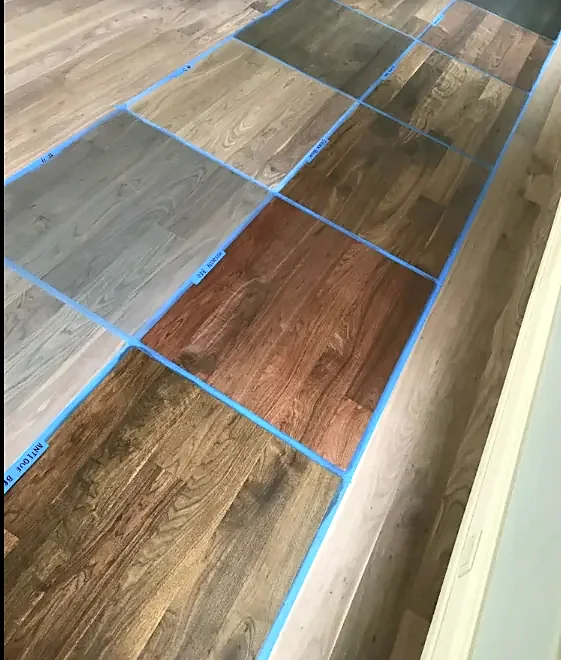
- Color. Keeping the natural color is simplest. A stain change, or matching red oak to white oak with bleaching and tinting, takes samples and extra steps. See color matching.
- The wood, for a new floor. Species, grade, width, solid or engineered, and whether it arrives raw to be sanded and finished on site or prefinished. See new hardwood.
- Pattern. Herringbone, chevron and parquet panels take slow layout and cutting, and a flatter subfloor than straight boards. See patterns.
- What is under the floor. A soft subfloor, a low spot in a slab or moisture has to be fixed first. Tony tests the wood and the subfloor for moisture before any installation. See subfloor and slab.
- Getting the old floor out. Carpet, old vinyl and linoleum, or worn-out hardwood. See tear-out.
- Stairs. Priced per step. La Cumbre does treads and risers. See stairs.
- The finish. Which product, how many coats and which sheen. See finishes.
- Access and furniture. Who moves it, and how much of the house has to stay usable during the job.
How long does it take?
| Step | Time |
|---|---|
| From your call to the estimate visit | 1 to 3 days |
| Refinishing one to three rooms | 4 to 7 days |
| Furniture back on the floor | 3 days after the last coat |
| Rugs back down | 30 days after the last coat |
The wait for furniture and rugs lets the finish cure. Rugs wait longest because they trap the finish under them while it is still hardening.
How do I read a flooring quote?
A complete quote names the product and finish, the square footage, the labor, what happens to the old floor, what it assumes about the subfloor, and what is not included. Two quotes that differ by thousands usually differ on those assumptions, not on skill. Ask each contractor:
- Does the price include removal and disposal of the old floor?
- What is assumed about the subfloor, and what happens if it is worse?
- Which finish, how many coats, which sheen?
- Is dust control included, and how does it work?
- Who moves the furniture, and who pulls baseboards?
- What is the payment schedule? See the California contract rules.
How much can a deposit be, and how do people pay?
California caps the down payment on a home improvement contract at $1,000 or 10 percent of the price, whichever is less. For a $4,000 job, that is at most $400. Later payments should follow a written schedule tied to work done. This comes from the state contractors board (CSLB) consumer guide.
La Cumbre takes check, card, Zelle or cash.
Sources
- Tony, owner of La Cumbre Floor Covering & Design: timing, payment and the smallest job, October 2026
- CSLB, Home Improvement Contracts consumer guide