
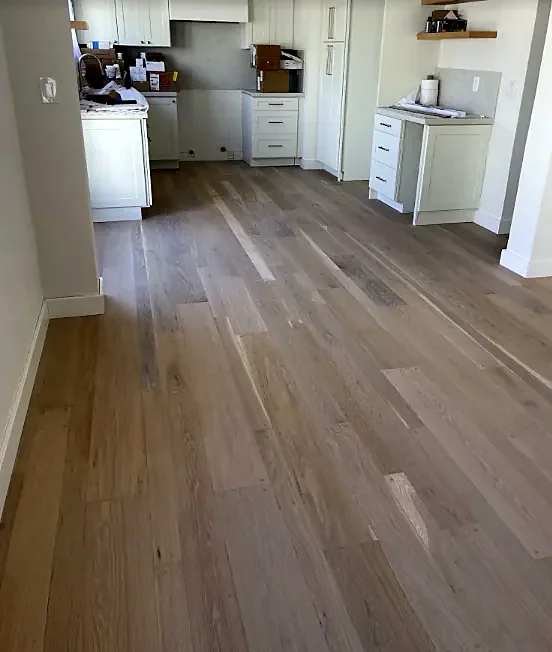
Tile and rigid-core vinyl handle water best. Wood and cork cannot take standing water. Carpet is comfortable but water-sensitive. Any floor over a concrete slab needs a moisture test first. La Cumbre works mainly with hardwood, solid and engineered, and also installs luxury vinyl plank, laminate and carpet, coats garages in epoxy and polishes concrete. It does not install tile. This page covers every floor, so you can decide with the facts.
Pick a room
Tap a room to highlight the options that suit it. These picks are our judgment from the facts below, not rules.
| Room | Strong options | Use caution with |
|---|---|---|
| Kitchen | Porcelain tile. Rigid-core (SPC) vinyl plank. Sealed clay tile in a period house. | Laminate not sold as waterproof. Floating cork. Bamboo. |
| Bathroom | Porcelain or ceramic tile (check its slip rating). Waterproof rigid-core vinyl. | Laminate, bamboo, standard cork, carpet. |
| Bedroom | Carpet with a Green Label Plus rating. Engineered wood. Hardwood. Cork. | Cold, hard tile unless you have radiant heat. |
| Stairs | Hardwood treads. Carpet. Tile or tread products with a documented slip rating. | Smooth laminate or glossy finishes. |
| Garage | Polyaspartic or epoxy coating, after the slab is ground and moisture-tested. | An unsealed slab if vapor is high. |
| Entry and indoor-outdoor | Porcelain, or sealed stone or clay tile. Check slip rating. | Cork, bamboo, laminate. |
| Homes with dogs | Tile. Rigid-core vinyl with a thick wear layer. Hardwood with a matte finish. | Smooth laminate (slippery for paws). Thin wear layers. |
| Homes with kids | Vinyl with a 20 mil or thicker wear layer. Tile. Carpet tile you can replace by the square. | Softer composite-core vinyl, which dents. |
| Aging in place | Low-pile carpet. Textured tile with a published slip rating. | Polished or glossy surfaces. |
The floors side by side
| Type | Water | Good to know |
|---|---|---|
| Solid hardwood | Sensitive. Standing water damages it. | Sanded and refinished many times. Moves with humidity. See new hardwood floors. |
| Engineered hardwood | More stable, still not waterproof | Refinishing depends on top layer. Needs a flat slab and a vapor retarder. |
| Luxury vinyl plank (rigid core, SPC or WPC) | Waterproof core. Water in seams or under the floor is the risk. | SPC is firmer and dents less. WPC is slightly warmer but shows an uneven slab. |
| Laminate | Water-susceptible unless sold as waterproof | Louder underfoot. Check formaldehyde certification. Bob Vila cites 15 to 20 years. |
| Porcelain tile | Very low absorption | Cold and hard. Needs a flat base. Excellent over radiant heat. |
| Ceramic tile | Absorbs more than porcelain | Easier to cut. Good with radiant heat. |
| Saltillo or terracotta | Porous. Needs sealing. | Heavy, irregular. Layout matters. Sealers need re-doing. |
| Carpet and carpet tile | Water-sensitive | Quiet and warm. Look for Carpet and Rug Institute Green Label Plus. Poor under electric radiant mats. |
| Cork | Core absorbs water; sealed or HDPE versions resist it | Fades in sun. Scratches. |
| Bamboo | Moisture-susceptible | Hardness varies widely by type. |
| Polished concrete | Sealed concrete resists water | Hard, cold, can crack. Slick if polished glossy. |
| Epoxy and polyaspartic (garage) | Limited by moisture vapor from the slab | Both need the concrete ground first. Polyaspartic vendors claim longer life than epoxy. |
“Waterproof” is a marketing word. Sources agree that a waterproof surface does not make the subfloor or slab waterproof. Most lifespan figures are retailer or manufacturer claims, so we left out the numbers we could not source.
What a concrete slab means
Slab moisture is the most-cited cause of floor failures. Test it before installing wood, vinyl or laminate. The common test is in-slab relative humidity (ASTM F2170): three tests in the first 1,000 square feet and one more per additional 1,000, with 75 percent or less typical. Floor makers set their own limits, so check the product. Raised foundations need a different check: keep crawl-space moisture under control, because a vapor barrier in the floor itself can trap moisture.
Flatness and settling in
Engineered wood on concrete is typically held to within 3/16 inch over 10 feet. Carpet tile and softer vinyl show every bump. Before they go down, wood and bamboo need time in the house, with the indoor air kept the way you will live in it.
Indoor air
FloorScore certification tests products against California’s Section 01350 emission method for 35 chemicals. The Carpet and Rug Institute Green Label Plus covers carpet, cushion and adhesive. Formaldehyde limits for plywood, particleboard and fiberboard are the same under the federal rule and California’s. Laminated products have been covered since March 2024.
Radiant heat
Tile and stone conduct best. Engineered wood and floating vinyl or laminate can work if the maker approves. One radiant maker gives 80 to 85 degrees as the limit. NWFA’s solid-wood guideline is 80 degrees at the surface. Carpet pairs poorly with electric mats. Check each product.
Slip resistance
The U.S. Consumer Product Safety Commission counted about 190,000 emergency room visits a year from floor slips. People over 75 are injured at more than twice the rate of those 65 to 74. If someone in the house is older, choose texture and a published slip rating over polish.
Which license covers what
California’s flooring license class, C-15, covers surface prep, carpet, resilient flooring and wood floors, including finishing and repair. It specifically excludes ceramic tile, which falls under a different class. See the hiring guide.
Sources
- Wagner Meters, concrete moisture testing
- Word of Mouth Floors, SPC vs WPC (retailer blog)
- Bob Vila, best flooring for dogs
- SCS Global, FloorScore
- EPA, formaldehyde emission standards for composite wood
- CPSC statement on floor coverings, Jan 2017
- Green Building Advisor, vapor barriers under vinyl (Q&A forum)
- NWFA, radiant floors, 2020
- CSLB, C-15 flooring and floor covering